Making non-concessional contributions can be an effective way to increase retirement savings, particularly when a member has substantial personal funds available to contribute to super. However, the amount that can be contributed without triggering additional tax depends on more than the annual cap.
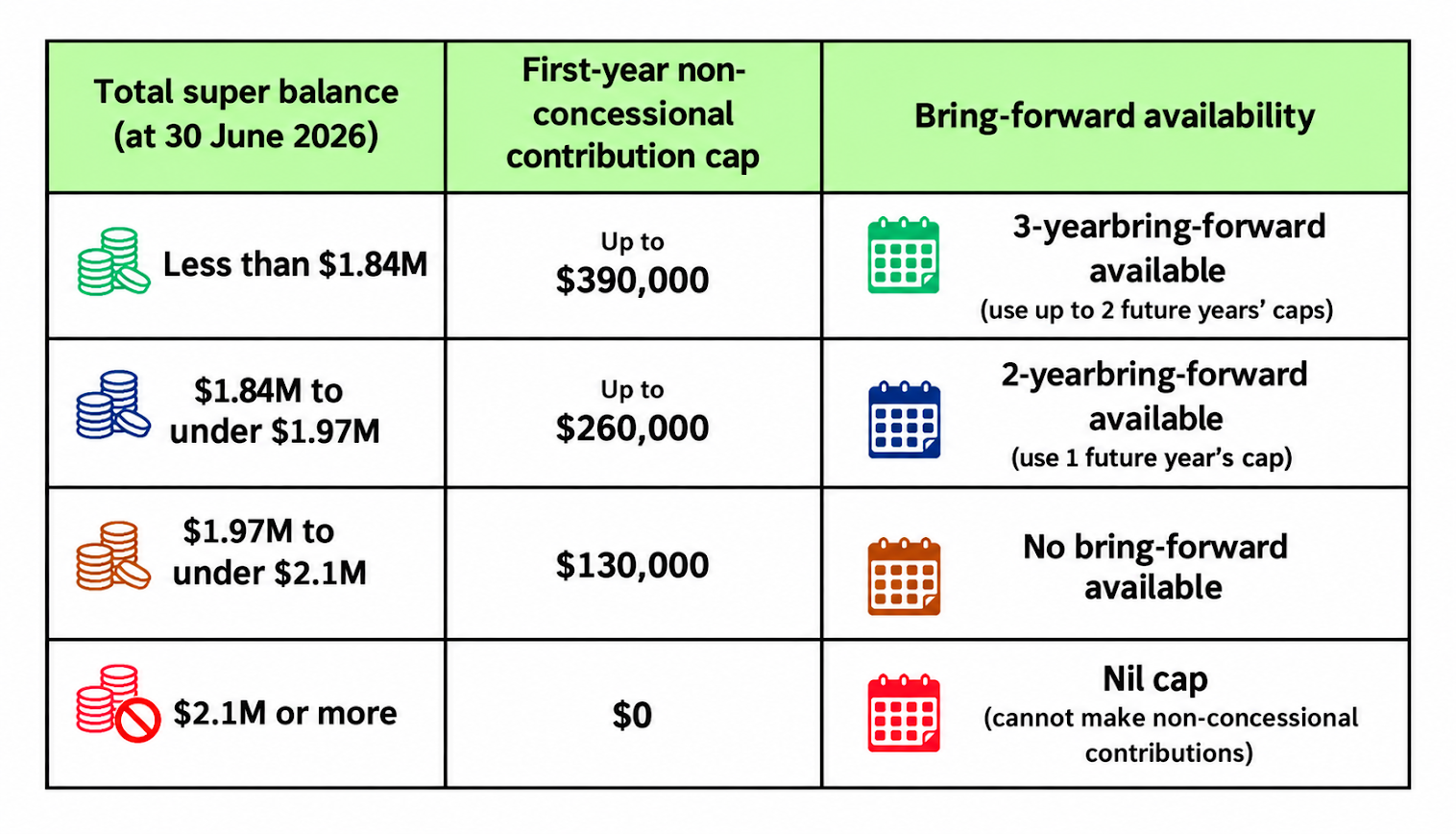
For the 2026-27 financial year, the standard non-concessional contributions cap is $130,000. Eligible members may also be able to access future years’ cap through the bring-forward arrangement, allowing up to $390,000 to be contributed in one financial year, subject to their total super balance and other eligibility requirements.
For the 2026-27 financial year, the standard non-concessional contributions cap is $130,000. Eligible members may also be able to access future years’ cap through the bring-forward arrangement, allowing up to $390,000 to be contributed in one financial year, subject to their total super balance and other eligibility requirements.
For SMSF professionals, accurate contribution tracking is critical. Contributions made across multiple funds, an existing bring-forward arrangement, the member’s total super balance and even the date a contribution reaches the fund can affect the amount available.
This guide explains the
2026-27 rules, how the bring-forward arrangement works, what happens when a cap is exceeded and what SMSF practices should consider when reviewing a member’s contribution position.
What Are Non-Concessional Contributions?
Non-concessional contributions are generally after-tax amounts added to super where the member does not claim a personal tax deduction. For SMSF practices, the key consideration is whether the member has sufficient contribution capacity before accepting or recording the amount. This requires reviewing contributions across all super funds, the member’s total super balance, previous contribution history and any existing bring-forward arrangement.
These factors can affect whether a proposed contribution remains within the member’s available limit. Accurate classification and contribution tracking are therefore critical when reviewing larger member contributions or planning future super funding strategies.
Concessional vs Non-Concessional Super Contributions
Understanding concessional and non-concessional contributions helps SMSF professionals assess contribution limits, tax treatment and member eligibility.
Non-Concessional Contributions Cap for 2026 - 27
A member’s total super balance (TSB) at 30 June 2026 affects their non-concessional contributions cap and eligibility for the bring-forward rule in 2026-27. The thresholds below show the maximum contribution limits based on the member’s balance.
Before accepting a large contribution, SMSF professionals should also check the member’s previous contributions and any existing bring-forward arrangements, as these can affect the member’s remaining contribution capacity.
How the Bring-Forward Rule Works
What Does the Bring-Forward Rule Mean?
The bring-forward rule allows eligible members to access up to two future years of non-concessional contributions caps in advance, subject to their total super balance and eligibility. This can help members with substantial personal funds add more to super within a shorter period, subject to their total super balance and contribution history.
Age Eligibility
Generally, members
must be under 75 at some point during the financial year to access the bring-forward rule, subject to applicable eligibility conditions. Their age, total super balance and any existing bring-forward arrangement should be checked before planning a large contribution.
Bring-Forward Cap by Total Super Balance
Benefits and Limits of Non-Concessional Contributions
Why Members Make After-Tax Contributions
Contribution Eligibility and Regulatory Limits
Contribution limits depend on total super balance, previous contributions and age. Members should check their eligibility, existing bring-forward arrangements and fund acceptance rules before making large contributions to avoid exceeding applicable caps.
What Happens If You Exceed the Cap
ATO Determination and Your 60-Day Election
When the ATO identifies excess non-concessional contributions, it issues a determination outlining the excess and available options.
Members generally have 60 days from the determination’s issue date to make an election about how the excess is treated.
Members can elect to release the excess contributions and 85% of the associated earnings from super. The ATO calculates the associated earnings, which are included in the member’s assessable income and taxed at their applicable marginal rate, with a tax offset applied.
Members can choose to retain the excess contributions in super and pay excess non-concessional contributions tax. The excess is taxed at the highest marginal tax rate, including the Medicare levy, currently 47%. This option may result in a significant tax liability.
SMSF professionals should track contributions across all super funds, check existing bring-forward arrangements, and monitor contribution timing. Members should follow the ATO determination process rather than attempting an informal withdrawal before receiving instructions. Accurate records help reduce reporting errors and unexpected tax liabilities.
How to Check Your Cap and Bring-Forward Status
Members can access ATO online services through their myGov account to review reported super contributions, total super balance and available non-concessional contribution cap information. Checking these records before making additional contributions helps identify existing bring-forward arrangements and potential cap issues.
Super funds may not
report contributions and balances to the ATO immediately. SMSF reporting can depend on the fund’s annual return and processing timelines, meaning online records may not reflect the latest transactions. SMSF professionals should reconcile fund records, contribution history and member balances before confirming available contribution capacity.
Conclusion
Effective superannuation management requires sound judgement, accurate records and consistent oversight. For SMSF practices, strong contribution controls can help
reduce compliance risks, support informed member decisions and maintain confidence in the advice process. As contribution rules and member circumstances change, having the right operational support becomes increasingly important. SuperRecords supports SMSF practices with technology-enabled services designed to strengthen operational capacity and control.
Partner with SuperRecords to strengthen your SMSF operations.
Contact us
Frequently Asked Questions