Hiring another accountant can appear to be the obvious response when deadlines are tightening, workloads are rising, and senior staff are spending more time on production work.
But for
accounting firm leaders, the better question is not simply whether the team is busy. It is whether the firm has a genuine capacity gap, and what is causing it.
This distinction matters as Australian accounting firms face continued pressure on talent and delivery capacity. CPA Australia reported in October 2026 that demand for accountants continues to outpace supply across the Asia Pacific region, alongside fewer graduates entering the profession and persistent retention challenges.
Before committing to another permanent hire, firms should understand what their current team can realistically deliver.
Understanding the accounting firm capacity gap
A capacity gap occurs when the work your firm needs to complete exceeds what the team can realistically deliver. A team of ten people does not have ten full-time equivalents of production capacity. Working hours are also absorbed by client meetings, leave, training, internal administration, supervision, reviews, and unexpected issues.
Capacity gap = required workload − real available capacity
If the result is consistently positive, the firm has a capacity shortfall that needs to be addressed. The important word is consistently.
Start with workload, not headcount
Accounting firm capacity planning should begin with the work entering the practice. Separate the workload into three categories:
This gives leadership a clearer view of whether pressure comes from sustained demand or a temporary peak.
Calculate your real delivery capacity
The next step is to determine how much work the team can realistically deliver. A simple model is:
Real available capacity = gross working hours − non-production time − capacity buffer
For example, a team may have 1,000 gross working hours in a month. After leave, meetings, training, internal administration and expected interruptions, perhaps only 720 hours are realistically available for delivery.
Using real available capacity rather than headcount gives leadership a more useful planning measure and prevents a common mistake: treating 100% utilisation as a sustainable target.
Calculate the capacity gap
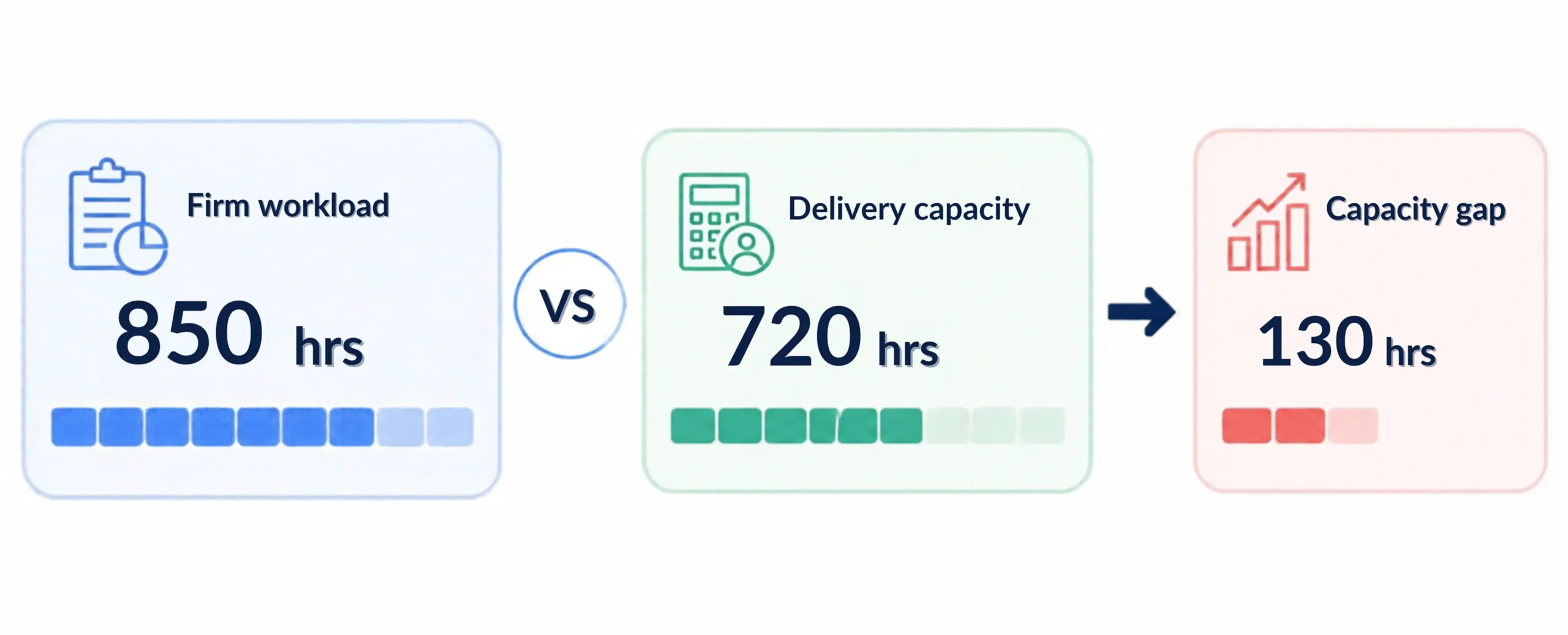
Now compare the workload with available capacity. Imagine the firm’s expected workload requires 850 hours, while practical delivery capacity is 720 hours.
That does not automatically mean the firm should hire. The next question is why the 130-hour gap exists. It could result from:
- Higher client volume
- Poor workflow allocation
- Senior staff completing routine production work
- Limited technical capability at certain levels
- Excessive review requirement
- Seasonal demand
- Rework caused by quality issues
The response should match the cause.
When should an accounting firm hire?
Permanent hiring makes sense when additional workload is likely to remain after seasonal fluctuations and process improvements have been considered.
For example, if the firm has consistently exceeded practical capacity for several quarters, has a strong forward pipeline and requires capabilities that cannot be developed quickly within the existing team, permanent headcount may be appropriate.
However, a permanent hire may not address a capacity problem caused by workflow, task allocation, or temporary demand. If senior accountants are spending too much time on repetitive tasks, the allocation of work may need to change. If inefficient processes cause delays, adding people may simply increase the cost of the same problem.
What work should remain under firm control?
Key decisions should remain under the firm’s control. This generally includes:
- Client relationships
- Complex technical judgement
- Final review and sign-off
- Advisory conversations
- High-risk decisions
- Practice strategy
The objective is not to move work outside the firm indiscriminately. It is to protect senior capacity for work that requires professional judgement.
Where can flexible capacity help?
Repeatable, process-driven work can often be separated from higher judgement activities. Depending on the firm’s operating model, this may include accounting preparation, reconciliations, documentation, SMSF administration, workpaper preparation and other defined production tasks.
This can give firms another option between two extremes: carrying permanent excess headcount or allowing service levels to deteriorate when demand increases.
For firms considering
outsourced accounting support, the key question should therefore be operational rather than purely financial: What capacity do we need, when do we need it, and what level of control must we retain?
Measure the result, not just utilisation
Once a capacity decision has been made, leadership should assess whether it is improving the firm’s delivery performance. Utilisation alone does not show whether the practice is using capacity effectively.
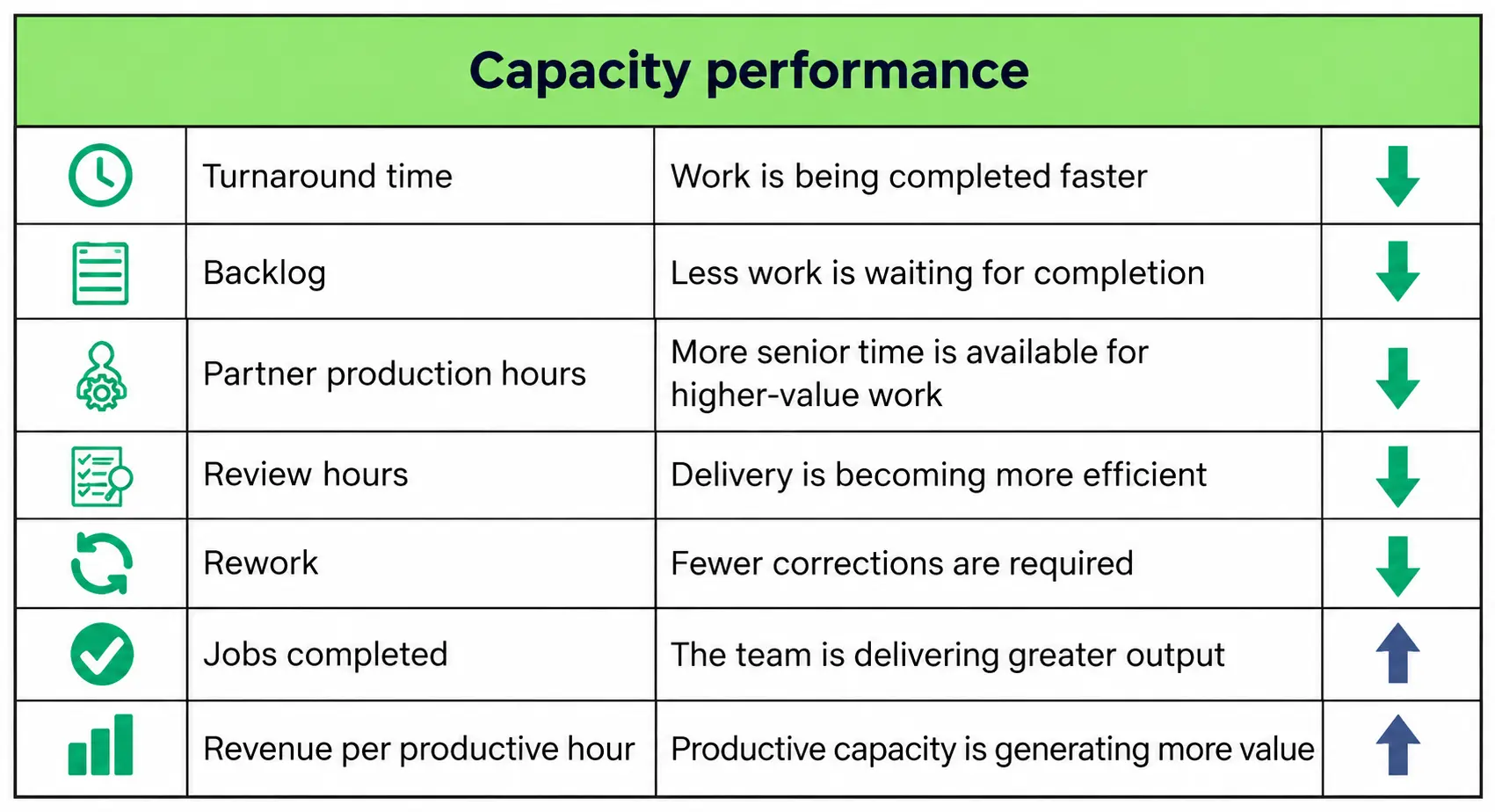
The following measures provide a broader view of capacity performance:
The direction of these measures helps assess whether capacity is improving. Lower turnaround times, backlogs, partner production hours, review hours and rework can indicate greater efficiency, while higher job completion and revenue per productive hour can indicate stronger capacity utilisation.
These measures should be viewed together. Higher output is not a positive result if rework, delays or review demands also increase. The goal is greater productive capacity without compromising quality or creating unsustainable workloads.
CPA Australia has also highlighted the need for accounting firms to balance technology with human capability. Its 2025 Business Technology Report found that 19% of surveyed Asia Pacific businesses had reduced or stopped filling junior accounting roles because of AI, while Australian businesses were among the markets planning increased AI investment.
For firms, the strategic issue is therefore becoming broader than hiring. It is about deciding how people, processes, technology and external capacity should work together.
Conclusion
The strongest capacity decisions protect service quality, partners’ time, and financial discipline simultaneously. When internal resources no longer match the firm’s operating requirements, SuperRecords can provide an alternative delivery model without making permanent headcount the default answer. The priority is to choose a capacity model that gives leadership greater control and predictability as demand changes.
Plan your firm’s capacity needs with SuperRecords and stay ready for growth.
Contact us
Frequently Asked Questions